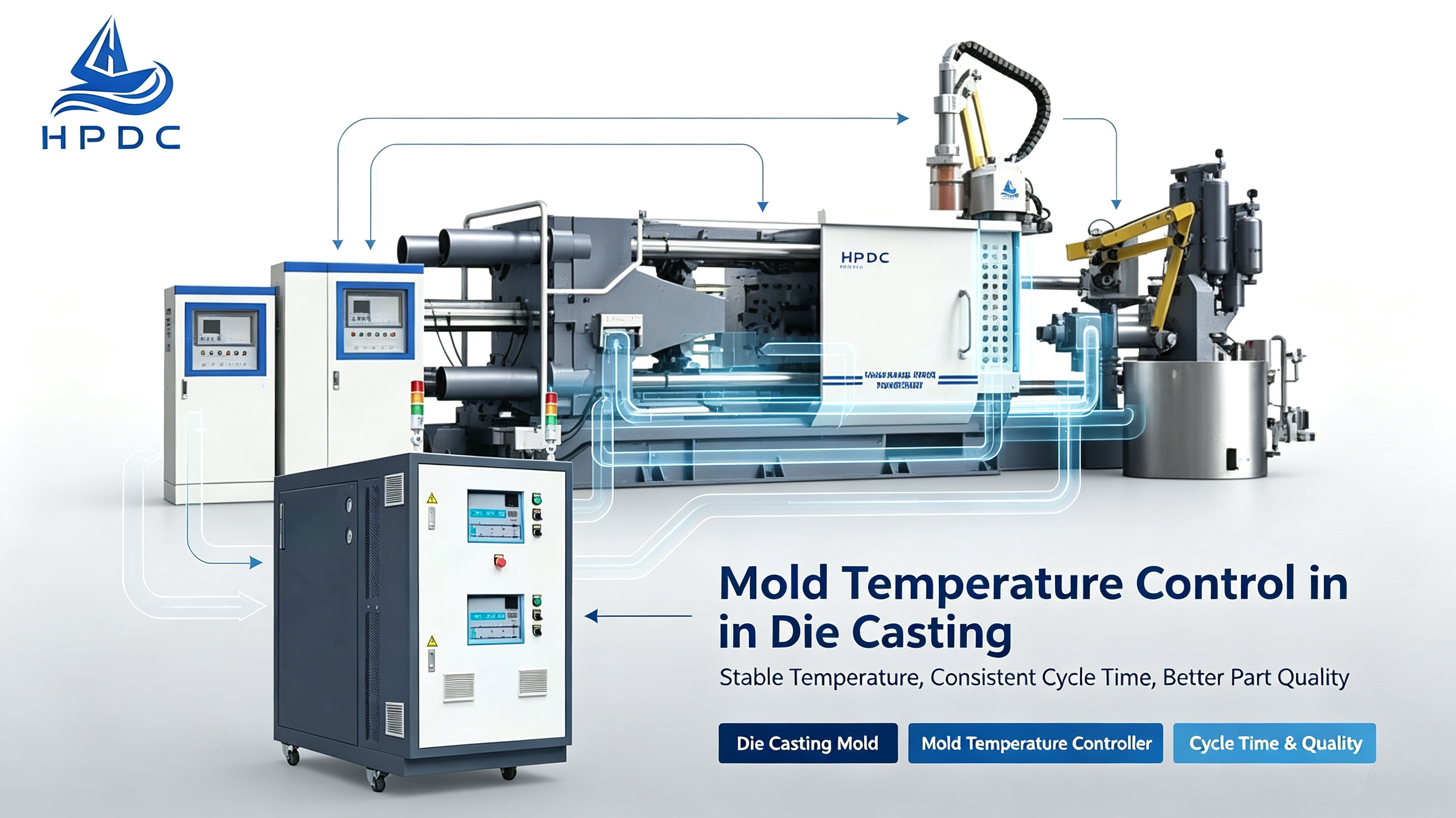
Die temperature control is one of the most critical yet underrated parameters in high-pressure die casting. It directly governs filling behavior, solidification speed, and thermal stability across every production cycle. Precise die temperature management balances fast cycle time and consistent part quality, while unstable thermal conditions inevitably cause low efficiency and high scrap rates.
1. How Die Temperature Affects Cycle Time
Cycle time in die casting mainly consists of filling, cooling, and ejection stages. Die temperature determines the minimum safe cooling duration, which dominates overall cycle efficiency.
Excessively high die temperature
Overheated dies slow down alloy solidification significantly. Prolonged cooling time becomes mandatory to avoid internal shrinkage and surface blemishes. Hot spots on the cavity further extend holding time, reduce daily output, and cause inconsistent cycle rhythm in mass production.
Overly low die temperature
Cold dies speed up surface solidification but create production bottlenecks. Premature alloy chilling leads to incomplete cavity filling and cold shut defects. Operators have to reduce injection speed and increase dwell time, which ultimately lengthens the total cycle instead of shortening it.
Stable optimal temperature
A balanced die temperature range (150–250°C for most aluminum alloys) enables predictable and uniform solidification. It allows manufacturers to adopt the shortest feasible cooling settings without defects, stabilizing cycle time and improving overall equipment efficiency .
2. How Die Temperature Determines Casting Quality
Thermal imbalance across die cavities is the root cause of most common die casting defects. Precise temperature control ensures uniform filling, sequential solidification, and stable dimensional accuracy of the die casting mold.
Surface finish and filling integrity
Moderate die temperature maintains sufficient molten alloy fluidity. It eliminates misruns, cold lines, and poor edge filling, delivering smooth and uniform surface texture. Too low temperature causes early skin solidification, while uneven thermal distribution results in inconsistent surface gloss.
Internal structural quality
Proper die temperature promotes sequential solidification from the part surface to the sprue. This orderly process effectively reduces shrinkage cavities, porosity, and internal residual stress. Overheated dies trap dissolved hydrogen and create micro-porosity, while rapid uneven cooling induces hidden internal cracks.
Dimensional stability and flatness
Uniform die temperature minimizes uneven thermal contraction during cooling. It greatly reduces part warpage, deformation, and dimensional deviation in mass production. Stable thermal conditions ensure consistent tolerance performance across every batch.
Reduction of die sticking and burrs
Excessively high die temperature increases alloy adhesion, causing die soldering and difficult ejection. This creates rough surfaces, burrs, and secondary scratching. Controlled temperature effectively lowers mold adhesion and reduces post-processing workload.
3. The Core Balance: Speed vs. Quality
Blindly lowering die temperature accelerates cooling but raises scrap rates. Continuously raising temperature improves surface quality but sacrifices productivity. Professional die casting production relies on thermal balance rather than extreme parameters.
Advanced mold temperature controller systems stabilize cavity temperature within a narrow tolerance (±10°C). This tight control synchronizes filling flow and solidification speed, achieving fast cycle time with low defect rates.
4. Bonus: Extended Die Service Life
Stable temperature control avoids drastic thermal shock and repeated hot-cold alternation. It reduces heat checking, surface cracking, and premature die fatigue. Longer die service life further lowers production costs and improves long-term production stability.
Conclusion
Die temperature control acts as the bridge between production efficiency and casting quality. Accurate, uniform, and stable thermal management shortens cycle time, eliminates common defects, and ensures batch consistency. For high-precision and high-volume die casting manufacturing, optimizing die temperature is the most cost-effective way to upgrade overall production performance.